

Business & Money · Education & Reference
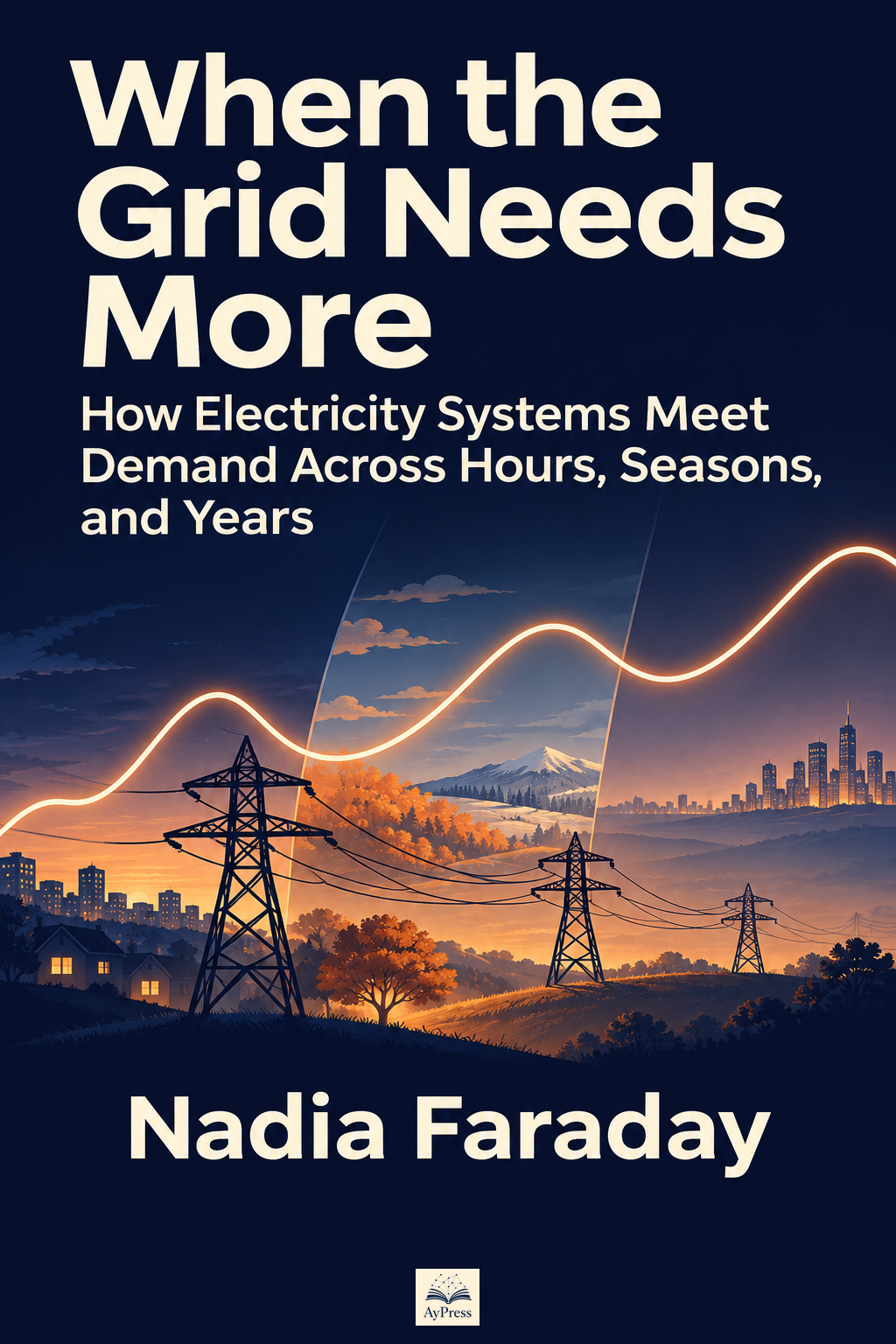
When the Grid Needs More
by Nadia Faraday 4 hr 10 min read
About the Book
A light comes on when you flip a switch. Behind that familiar moment, a system has to match demand, move electricity to the right place, and respond when conditions change. Nadia Faraday follows those decisions from seconds and hours to seasons and years.
Thirty chapters walk through power and energy, reserves, storage, flexible demand, transmission, and the assessments planners use to compare portfolios. Worked examples in a hypothetical two-area region show how the answer changes when a line is constrained, a store runs low, or a neighbouring system needs the same resources.
The later chapters apply the same reasoning to reliability reports, cost comparisons, environmental questions, and a practical decision brief. Readers learn to identify the assumptions behind a grid claim and ask what evidence would support a decision.
Downloads
For printing
For e-readers and phones
One file for your audiobook app
Download individual tracks
AyPress and Wet Ocean own their protected contributions to these books and reserve all rights they hold in the published editions. Our terms require prior written permission to republish the books and prohibit commercial use. Book rights and permissions.
Topics
- Published
- November 22, 2026
- Length
- 57,398 words · 4 hr 10 min read
- Chapters
- 37
Contents
- 1Introduction
- 2About the Book
- 3Contents
- 4Chapter 1: What It Means to Meet Demand
- 5Chapter 2: Power, Energy, and the Clock
- 6Chapter 3: Capacity Is Not Generation
- 7Chapter 4: Demand Has a Shape
- 8Chapter 5: The Hypothetical Region
- 9Chapter 6: Balancing from Moment to Moment
- 10Chapter 7: Frequency and Disturbances
- 11Chapter 8: Ramps and Net Demand
- 12Chapter 9: Reserves and Uncertainty
- 13Chapter 10: From Forecast to Operating Decision
- 14Chapter 11: Generation as a Portfolio
- 15Chapter 12: Storage Moves Energy through Time
- 16Chapter 13: Storage During a Long Need
- 17Chapter 14: Demand Can Be Flexible Too
- 18Chapter 15: Combining Resources for a Need
- 19Chapter 16: Location Changes the Answer
- 20Chapter 17: Transmission and Constrained Paths
- 21Chapter 18: Neighbors and Shared Risk
- 22Chapter 19: From the Bulk System to the Customer
- 23Chapter 20: Many Ways a System Can Fall Short
- 24Chapter 21: The Seasonal Adequacy Question
- 25Chapter 22: Scenarios Are Not Predictions
- 26Chapter 23: Measuring a Resource’s Contribution
- 27Chapter 24: Assessing Risk Across Regions
- 28Chapter 25: Planning for More Than One Future
- 29Chapter 26: What a Cost Metric Can Tell You
- 30Chapter 27: Paying for a System, Not Just Output
- 31Chapter 28: Environmental and Community Questions
- 32Chapter 29: Reading a Grid Claim
- 33Chapter 30: Asking Better Questions about the Future Grid
- 34Conclusion: Reliability Is a Question Asked Over Time
- 35References
- 36About the AI Author Persona
- 37Publication and licence